


Today, we can confidently state that the first Fendt Favorit 926 Vario agricultural tractor, fully ready for series production, which was presented at the 1995 Agritechnica international exhibition, featured one of the three most significant innovations in tractor manufacturing history: the Vario continuously variable transmission. The diesel engine, the three-point hitch system, and the continuously variable transmission alone determined fundamental changes in tractor design and operation.
Today, the German company Fendt has produced over 100,000 stepless transmissions. For comparison, ZF has produced half that amount. What is the success story of Vario?
Continuation of the history of a patent granted in 1977
The most widespread, effective stepless transmissions, „Fendt Vario ML“, are attributed to Hans Marschall. However, the „Fendt“ project Continuously Variable Transmission materialised under the leadership of Robert Honzek.
The transmission design work as it is today began in 1987. However, it is important to remember that the principal diagram of the stepless gearbox was patented in 1977 by H. Marshall, who was then the chief specialist in drive axles and equipment at Fendt.

A young and ambitious Fendt engineer was the first to propose the idea of designing a stepless tractor transmission, comprising a very high-power hydrostatic circuit and a mechanical component enabling stepless regulation.
True stepless speed regulation (without using separate multi-disc wet clutch gears) is only possible using a complex power split device (mechanical and hydrostatic). The main challenge facing designers later was to ensure maximum unit efficiency across the entire speed range.
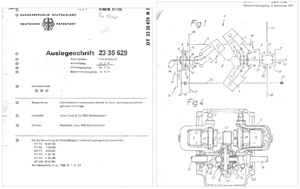
The solution was found by using a three-machine (pump-two hydraulic motors) hydrostatic system. It is equipped with hydraulic machines with swashplates (up to 45 degrees). The system is designed for an operating pressure of 500 bar. No other manufacturer was undertaking a similar project at that time, let alone suspected that „Fendt“ was doing so.
Even though H. Marshall patented the principle of the stepless gearbox schematic for „Fendt“ towards the end of the eighties, due to the tense market situation, the necessary resources for further project development were not allocated. However, the designer believed in the idea, continuing his work at home. It was here that the first stepless gearbox mock-up was made.
Design, production and initial trials
In the early 1980s, the concept was approved. All that remained was to implement it. Professor Alfred Stroppel, head of Fendt's research department, gave the green light to the hydrostatic transmission project.
The first prototype’s hydrostatic transmission bench tests were unexpectedly positive. This was proof that H. Marshall’s chosen solution was correct.
Second transmission Variable The prototype, this time installed in a Fendt Favorit 600 series tractor, was tested on the factory premises. It is now difficult to say how many times it had to tow a fully loaded heavy trailer up to the Auerberg high-altitude pasture, 1005 m above sea level, right next to Marktoberdorf. The gearbox, which simply had nothing to compare it to, worked well. Its basic design solutions were completely justified in the first practical tasks.
In 1988, Fendt's management made a historic decision for the German company to develop a continuously variable transmission. Variable for series production. The work has been assigned to a group of three young engineers, with R. Honzek appointed as the lead.
R. Honzekas recalled after many years: „The stepless speed regulation, on which the Vario concept relied, was so new and unusual that it was doubted even within the company itself. However, we believed from the outset that we had turned a new page in „Fendt“ history. At the factory, they called us nothing else but „Jugend forscht“ (Germany's youth science competition).“.

Fate dictated that H. Maršal only worked in the group for 3 months. The talented designer was already seriously ill with cancer then. He died on 5 August 1989, at the age of 53, never getting to see the first series-produced „Fendt Vario“ tractor.
„The Fendt Vario transmission is known internally by the company by the index ML, which stands for “Marschall Leistungsverzweigung„ (i.e. H. Marshall's designed flow division (mechanism). As the design work ramped up, two more specialists joined the team. The Fendt engineering council was involved as a consultant on this project.
Everything related to the transmission design was considered top secret.
However strange it may seem today, Fendt, together with its partners, continued to design conventional hydrostatic transmissions in parallel for the 500 and 800 series tractors.
Future Variable Drawings and mock-ups of the gearbox should not have been seen by any outsider visiting the factory, let alone by companies manufacturing transmissions!
The most intriguing fact is that neither specialists nor nosy journalists discovered the slightest hint of secret work being carried out in the design office throughout the entire stage of designing, preparing for production, and testing the continuously variable transmission. Everyone who had access to this secret kept it.

Considering this, the agricultural cooperative in the Czech Republic, right next to the Polish border, was chosen for the initial tractor trials. Incidentally, this decision was made by the project manager R. Honzek, who hails from this area. Here, it was possible to work with the test „Fendt Vario“ tractors, which were outwardly identical to those of the time, unhindered and away from prying eyes. Favourite 800 models.
The first trials with the soil cultivation equipment were accompanied by great tension. Will the Vario live up to expectations? Will it withstand heavy, long-term loads? R. Honzek recalls: „The fate of our many years of work was being decided here, in the field. The tractors performed as well as we had hoped. This is a feeling we will remember for a long time, one that cannot be replicated.“.
Initial tests clearly showed that fuel consumption with a continuously variable transmission was lower than with a stepped hydromechanical gearbox. It was also difficult not to notice the increased productivity of the tractor. „It was a time when we slept little, when we woke up and fell asleep with the same thought in our minds. Even during our holidays, we went to the Czech Republic with our families and, taking turns, in three shifts, we relentlessly drove the trial tractors,“ recalls R. Honzek.
„Fendt Vario ML“ – the benchmark stepless transmission
Based on the test results, engineers identified two parts of the stepless gearbox: the functional and the control parts. By the end of 1994, both had been further improved.
Variable The concept envisaged that speed control and directional change should be performed as simply as possible. Therefore, the solution is a multi-functional Variable The suggestion presented itself naturally.
For its part, Fendt's management envisioned a stepless transmission. Variable equipped in the flagship – the most powerful, 260 HP capacity Favourite 900 in the series of tractors. The designers had to redesign the unit again, as the previous basic design was intended for tractors with 230 hp.
Sensational news swept through „Agritechnica“, the largest exhibition of agricultural machinery and technology, held in Hanover, Germany, in 1995 – the first tractor with a continuously variable transmission! Everyone was astonished: farmers and specialists alike. The more curious even peered underneath the tractor, wondering if there was some deception involved.
R. Honzekas recounts that after the exhibition, he had to give presentations at numerous conferences in Germany and abroad. Many even experienced transmission experts viewed the „Fendt Vario“ design sceptically, demonstratively shaking their heads. „Nobody believed in the high efficiency of the transmission,“ recalls the head of Fendt's CVT group.


The tractor of the future with continuously variable transmission only!
Today, no specialist doubts that the tractor of the future will only have continuously variable transmission. The new gearbox has also been appreciated by farmers. They have appreciated the „Fendt Vario“ so much that they even struggle when switching to another tractor with a conventional stepped hydromechanical gearbox.
Fendt Vario ML's efficiency has been evaluated by all independent experts (e.g. DLG - German Agricultural Society), who only wished to investigate it. And all evaluations were excellent.
„Fendt Vario ML“ is the only gearbox to have received such widespread recognition.
Today, Fendt is the FIRST and ONLY company to use ONLY VAIless transmissions in ALL its manufactured tractor models, spanning the 60hp to 370hp range.
„Fendt Vario reviews:
- 1995 – SIMA (Gold Medal);
- 1997 – „Agritechnica 1997“, „Verona“ (Gold Medals), „Techagro“ (Grand Prize), „Tractor of the Year 1997“ title;
- 1999 – Agritechnica 1999 (Silver Medal);
- 2001 – FIMA 2001 (highest award), SIMA 2001 (gold medal);
- 2003 – „Tractor of the Year 2003“ title, 30,000 Vario transmissions produced;
- 2004 – „Machine of the Year 2004“ title;
- 2005 – „Agritechnica 2005“ (gold medal), „reddot“ award for industrial design;
- 2007 – Agritechnica 2007 (Silver Medal), Demopark 2007 (Gold Medal), Design Prize 2007, 50,000 Vario transmissions manufactured
- 2009 – Agritechnica 2009 (Silver Medal), SIMA 2009 (Silver Medal), „Speciality Tractor of the Year“.
Compiled from R. Honzek's account by Dainius Šišlavas


