
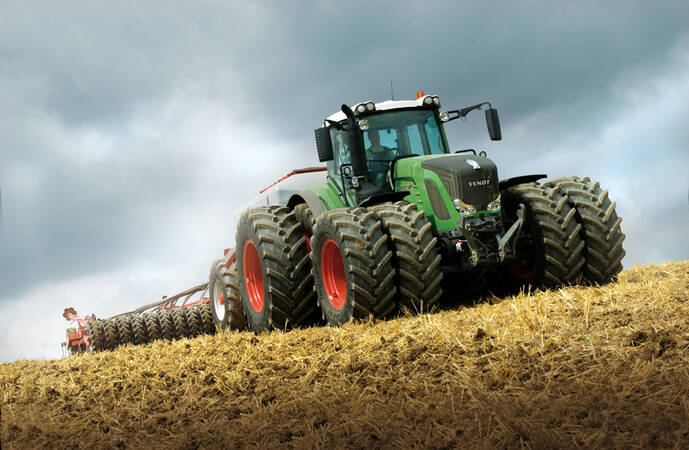
2011 marked a new chapter for Fendt. All machines bearing the Fendt brand would gradually have to meet the definition of „effective technology“: creating even greater added value with lower operating costs. Technology is only recognised as effective if it meets four basic criteria: it embodies Fendt's core values, is innovative, provides tangible benefits to the user, and is environmentally friendly.
New flagship – 390 HP tractor
At the largest Fendt field day held on September 2nd in Vadenbrune (Wadenbrunn), Germany, which is visited annually by over 50,000 guests, the first models of the company's „effective technologies“ were presented: the new generation „Fendt 800 Vario“, which debuted in Lithuania this year and was awarded a medal at the exhibition „Ką pasėsi… 2010“ (What you sow...).TMS“and updated Fendt 900 VarioTMS“tractor series with a new flagship – the „Fendt 939 VarioTMS“The Jis – the world's most powerful traditional construction tractor.
As with the new Fendt 800 VarioTMS“In the series, covering the 144 kW/196 hp – 211 kW/287 hp (EC 97/68 standard) range, the new 900 VarioTMS Instead of an exhaust gas recirculation system Rex install Selective Catalytic Reduction catalysts SCR, using a 32.5 per cent urea water solution AdBlue. As this is an external exhaust treatment device, it allows for optimisation of the combustion process, an increase in the cooling system's efficiency, and consequently, the engine's efficiency. The engine is noticeably more dynamic. Furthermore, engines with SCR catalysts are more economical than their predecessors.
All new high-power class tractor engines comply with the stricter regulations that will come into force on 1 January 2011. Stage IIIB/Tier 4 emission requirements.
Fendt 939 Vario tractorTMS“Fitted with a 7.8-litre, 287 kW/390 hp Deutz AG engine. At reduced revs of 1450 rpm, it generates an impressive 1547 Nm of torque. The engine is highly flexible, with a 31% torque reserve.
Compared to lower-powered modifications, the new engine features an increased piston diameter and stroke. A more efficient cooling system has been used, and a new turbocharger with an electrically controlled pressure regulator has been installed. The fuel system is accumulator-based, with a high injection pressure of up to 2000 bar, and is second-generation. common rail.

„Fendt 900 VarioTMS“as in reference high-power class tractors, more advanced innovations have been implemented. For example, in the x5 cabin, which is the most spacious, has the largest glazing area (5.5 m2) and the widest viewing angles (320 degrees horizontally and 145 degrees vertically) in its class, a control terminal has been used. Varioterminal with the largest touchscreen (10.4″). Depending on the equipment, a smaller 7″ touchscreen is also available.
Installed on tractors ISO-Bus aggregate control line, an automatic steering system can also be installed VarioGuide, Work accounting software VarioDoc on a remote data transmission protocol Bluetooth, external cameras. All these measures are monitored and controlled via the aforementioned terminal.
The first tractors in manufacturing, the new 900 VarioTMS The series tractors will be able to have a manufacturer-fitted two-line tyre pressure regulation system. VarioGrip, having been unveiled last year at the Agritechnica 2009 exhibition. Incidentally, the German Agricultural Society DLG awarded this innovation a silver medal.
The pressure for the front and rear wheels can be set in advance or directly during operation. Due to the use of a higher-performance air compressor, increasing the tyre pressure by 1 bar takes approximately 10 minutes. Reducing the pressure value by 1 bar takes approximately 2 minutes.
Different pressure values for field work and transport operations are saved in memory. Parameter changes and monitoring are performed on the touchscreen. Varioterminal screen. Additionally, the driver can set limit values for maximum and minimum tyre pressure, upon reaching which they are informed by an audible signal. If a trailer coupling is used ISO-Bus The control line has adjustable pressure.
According to the manufacturer's calculations VarioGrip The system installation costs are fully recouped, depending on the operations performed, after 2-4 years of use.
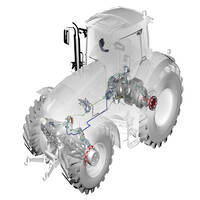
Another significant innovation in the high-speed agricultural tractor segment is the two-circuit pneumatic anti-lock braking system (ABS) - a first in tractor production for this type of drive! The system has four sensors in the wheels (which have individual disc brakes), two modulators for the front and rear wheels, and a control unit. The ABS system ensures safe manoeuvring when braking on corners, with wheels rolling on surfaces with different grip.

In the new Fendt 900 VarioTMS“The series provides engine protection against transmission overloads. Clutch actuator – in the GTV drive. Consequently, the engine is not stopped during momentary GTV drive overloads. When the electronic control system detects a sudden drop in engine speed, the GTV clutch is automatically disengaged. The power unit is protected from damaging forced stopping by interrupting the oil supply for lubrication and cooling of the turbocharger shaft.
„Fendt 900 VarioTMS“as well as the new 800 VarioTMS, but it is offered in three equipment levels: Power, Profi or Profi Plus.
Rear lift for new 800 and 900 VarioTM series tractors
To increase the versatility of high-power tractors, the front loader is not used due to the specific design of the chassis. However, Fendt has found an original solution.
The front „Fendt Cargo 4X85“ loader, with its side mounting supports, is attached to the rear tractor's electro-hydraulic lift via a special bracket. With the optional reversible workstation and hydraulic lower link stabilizers, the 800 and 900 series high-performance tractors become truly versatile machines. When the seat with all controls is rotated 180°, the driver gains an excellent view of the work area, better than when the loader is mounted at the front.
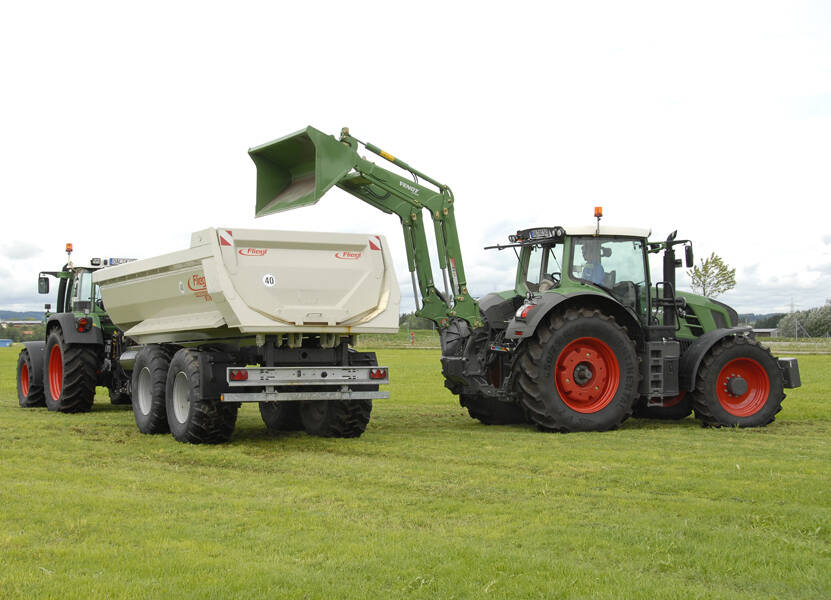
With the lower tractor linkages in the horizontal position, the Fendt Cargo R loader can lift loads up to 3.0 tonnes to a height of 4.125 m. When the lower linkages are raised to the top position, the load is lifted to an impressive height of 5.05 m.
The articulated loader conveniently loads and unloads semi-trailers with high sides, loads large diameter rolls or straw bales, services large capacity feed mixers-blenders-distributors, biogas reactors, etc.
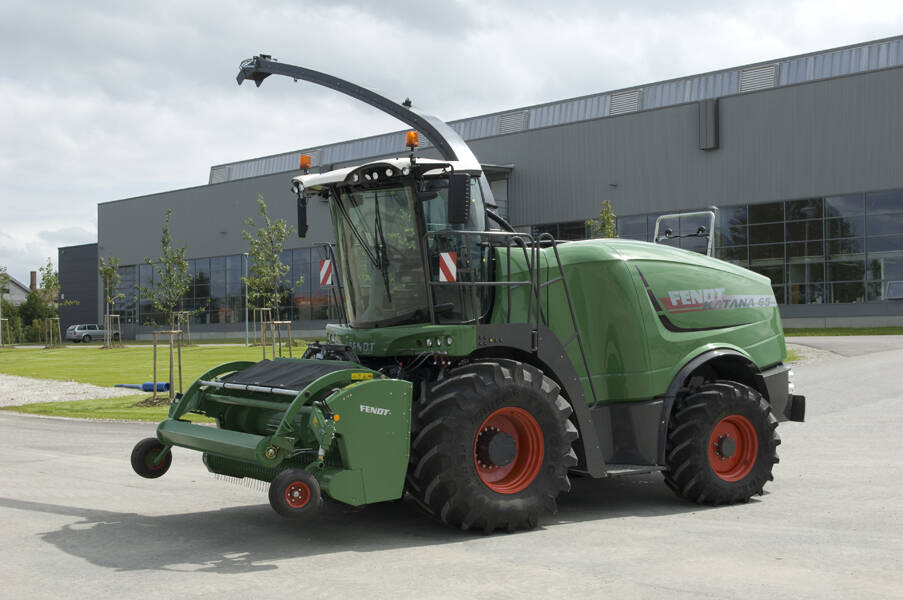
The first Fendt self-propelled forager – Katana 65
Vadenbrune has unveiled the most powerful Fendt-branded machine ever – a self-propelled forage harvester with 650 hp. Katana 65. In Japanese, „katana“ means one of the longest curved samurai swords, unmatched in manufacturing precision and sharpness. This is the kind of high-end, professional machine that Fendt’s engineers aimed to create.
Katana 65 It was designed at the Fendt technology centre in Marktoberdorf. As the machine was designed from scratch, the company's full engineering potential, accumulated in the design of hydraulic and electronic control systems, was utilised. Experience in engine, power transmission and cabin layout design was also leveraged.
The self-propelled shredder being manufactured will be in Hohenmölsen, Germany, where production facilities acquired in 2009 are today being finalised for the production of these machines.
The design of the self-propelled forage harvester is geared towards achieving maximum efficiency: a massive chopping drum with the largest diameter on the market (720 mm), and 6 feed rollers for uniform mass feeding. For direct-cut headers intended for preparing silage from mixtures or grain crops, proven and practical „Kemper“ solutions have been used in the construction of the disc-knife cutter.
Future users will be able to appreciate the exceptional cab of the self-propelled forage harvester with its original multifunction control console. Some of the control elements are unified with those used in the new Fendt 800 and 900 VarioTMS The series includes, for example, a terminal with the largest (10.4″) diagonal touchscreen. The electronic control systems are interconnected with multiplexing. CAN-Bus lines.
The self-propelled chipper is fitted with a 16-litre V8 Daimler OM series engine with a power output of 650 hp. Due to the fitted selective catalytic reduction catalyst (SCR), the engine complies with Stage IIIB/Tier 4 emission requirements.
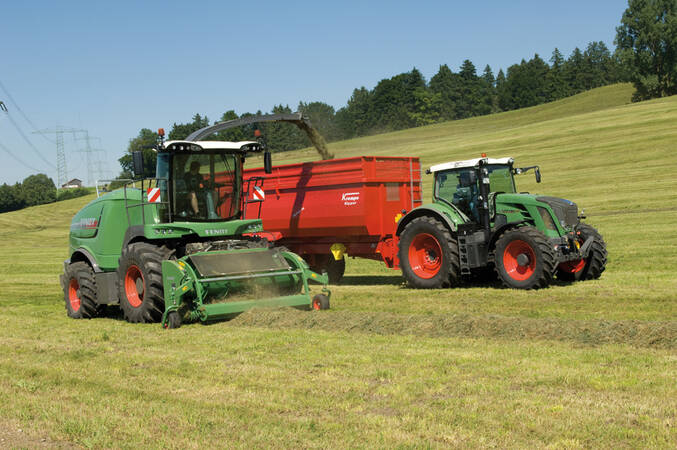
„Fendt Katana 65 rear axle – suspended. Thus, the maximum transport speed is 40 km/h.
The Katana 65 bus will be launched early next year. Later, the self-propelled chipper range will be expanded with models of both lower and higher power.


