
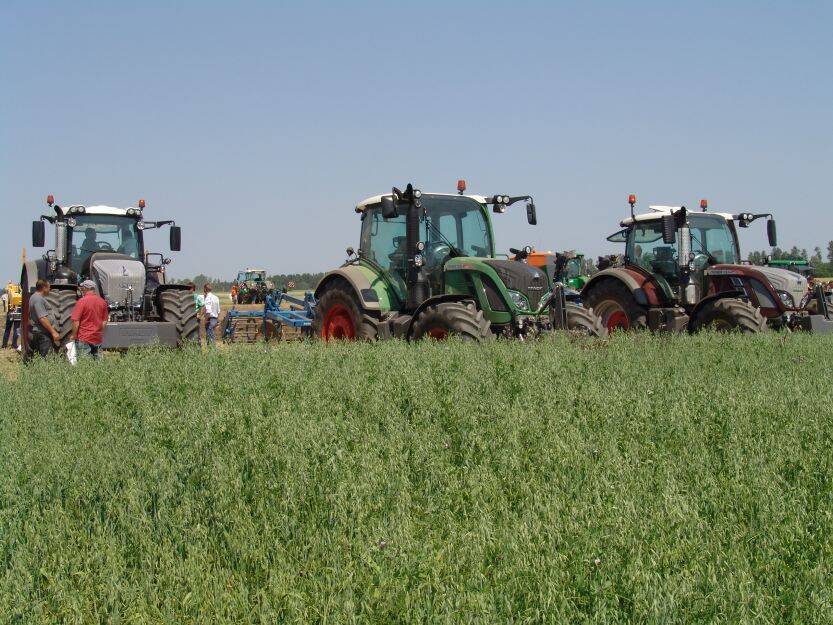
At the „Agritechnica“ trade fair, the largest international exhibition for agricultural machinery and technology, which took place from November 15th to 19th, the German Agricultural Society (DLG) awarded Fendt one gold and two silver medals for significant and substantial improvements to machinery work processes.
The highest rating was awarded to the company for its machine-to-machine (Vehicle-to-Vehicle, V2V) interface. GuideConnect. Silver medals awarded for a tractor loader Cargo Pro with integrated electronic scales and a memory function installed in the control system and the new „Fendt 700 Vario“ An automatic pressure regulator installed in the proportional hydraulic system of the front linkage ensures precise copying of the surface of the equipment suspended on the front linkage.
„The Fendt machine-to-machine (V2V) interface, GuideConnect, which was quickly dubbed the “electronic tow rope,„ has been recognised by the commission as an essential and significant improvement to the machine's workflow. By using lower-powered tractors, the manufacturer has managed to combine a wide working width with compact transport dimensions. Greater technological flexibility and reduced soil compaction from the lower-powered tractors have also been taken into account.
The solution offered by Fendt is halfway to fully automated remote operation of farm machinery. The core of the proposed machine-to-machine concept is that one operator can control two machines. This solution is the first of its kind to be presented on the market.
„Fendt specialists have succeeded in combining a large working width with compact machine dimensions. Under normal conditions, higher productivity can be achieved by working with wider implements, but they must meet strict requirements for transport on public roads. By synchronising the operation of two tractors, coupled with narrower implements, the same amount of work can be carried out. An additional positive effect is that the use of lower-powered tractors can be combined with greater technological flexibility and reduced soil compaction.
„Fendt Master-and-slave The hierarchy is distributed between two tractors: the main, controlling one, which is operated by a human, and the controlled tractor, which follows the trajectory set by the first one. The latter tractor not only follows the first one in a straight line but also synchronously performs manoeuvres, for example, when going around obstacles.
When the controlling tractor approaches an obstacle, the speed of the controlled tractor is automatically reduced. It is only increased again once the first tractor has completed its manoeuvre and accelerated to the set technological speed. When the controlling tractor approaches the headland, the controlled tractor stops and waits for the first machine to turn around. Only once the first machine has completed its manoeuvre does the controlled tractor repeat the same action.
The lifting and lowering operations for the aggregates are automated using a program that creates a command sequence in the end-to-end space. Variotronic TI.
Information exchange between the tractors takes place via a long-range wireless radio connection, and both are equipped with high-precision automatic steering systems with corrective RTK-GPS signal receivers. Before starting work, the operator selects on the Vario touchscreen which tractor will be the controlling one and which will be the controlled one. It is set how far the controlled tractor will travel behind and what the distance will be to adjacent technological rows.
The operator, from within the driver's cab of the tractor, monitors the work of both machines. All vital information on the tractor following behind and the implement attached to it is available to him: engine speed, travel speed, fuel level remaining in the tank. In machines with the next generation GuideConnect interface, even more data will be available to the operator, and a system of sensors registering changes in the tractor's environment will be fitted.
Given that one operator is entrusted with controlling two machines simultaneously, great attention has been paid to ensuring the safety of the technological operation. The wireless connection between the two specific tractors is encrypted, so there is no risk if other machines, controlled via an analogous GuideConnect interface, are operating nearby. Furthermore, there is no risk of machines not connected to each other, but controlled via the GuideConnect interface, colliding.
In critical situations, for example, when the satellite navigation system signal is lost or radio communication between two machines is interrupted, or when the distance to the vehicle in front increases or decreases, the autonomous tractor is automatically braked. When this tractor stops, its engine is also switched off for safety reasons.
Real-time control of two machines by a single operator significantly increases work efficiency. The principle offered by Fendt is suitable for controlling tractors not only of the same but also of different power classes, which are aggregated with technological equipment of the same or different types.
GuideConnect's contribution is important not only for synchronising the actions of two machines, but also as a significant contribution to the further automation of technological processes in agriculture.
Fendt 700 Vario model range from 145 to 240 HP
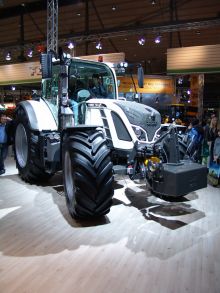
„Agritechnica 2011“ saw the introduction of three new, smaller models in the „Fendt 700 Vario“ series: 714, 716 or 718. So now the range of compact high-power tractors comprises six models, covering the 145-240 hp range.
„The Fendt 700 Vario is the third Fendt tractor series in a row that embodies the company's new direction – “efficient technology„ – which states that greater added value can be achieved with lower operating costs. The aspiration to get “more from less„ was already implemented during the design phase of the new tractor.
The lower-powered Fendt 700 Vario models use the same 6.06 l displacement engine as the more powerful models, equipped with an external exhaust gas treatment system – a selective catalytic reduction catalyst (SCR) using a urea-water solution. AdBlue. As a result, the engine complies with the transitional Stage IIIB/Tier 4 emission requirements, which came into force on 1 January this year.
The use of a selective catalytic reduction (SCR) catalyst does not affect the engine's operating process – exhaust gas treatment occurs exclusively in the exhaust gas discharge tract. Disengaging the exhaust gas recirculation system reduced power losses in the cooling system. All of this allows the engine to operate in a more efficient and economical mode.
Internal Fendt tests show that due to the use of SCR technology, the tractor 700 Vario, with average fuel consumption of 20 l/h, saves up to 2 litres of fuel per hour. This means that 20,000 litres of diesel are saved over 10,000 operating hours.
The tractors are equipped with an advanced design, newly engineered cab VisioPlus, which can have a three-stage damping system, an improved electro-hydraulic rear and front lift control system has been installed Variotronic. It is worth emphasising that due to the rational arrangement of controls, intuitive tractor operation and the ability to automate any machine function, the number of hand movements can be significantly reduced. For example, when working with all new Fendt Vario tractors, including 700 Vario, This means that for every 10 working days, the driver will not have to make up to 1920 extra hand movements.
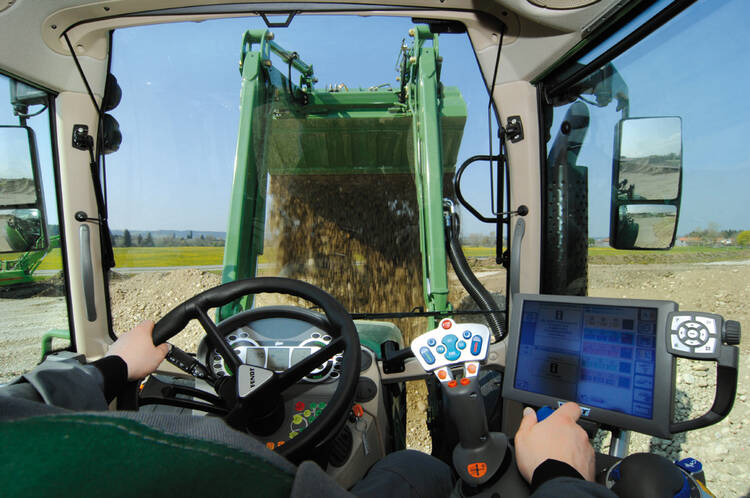
The latest Fendt 700 Vario tractors are fitted exclusively with a stepless dual-range transmission with overload protection. Turboclutch. Hydro-mechanical gearbox Vario ML ensures maximum continuously variable tractive force across the entire speed range, from 20 m/h to 50 km/h.
For the first time, a compact tractor can be equipped with 7 pairs of hydraulic connections: 5 at the rear and 2 at the front. It's important to note that the front connections are completely autonomous, i.e., not directly linked to the rear ones. The lowering speed of the rear hitch's lower links is now independent of the load: whatever lowering speed you set for a full fertiliser spreader, it will remain the same even when the fertiliser box is empty. The front electrohydraulic hitch's proportional control system is additionally fitted with an automatic pressure regulator, ensuring better surface copying of the implement mounted at the front.
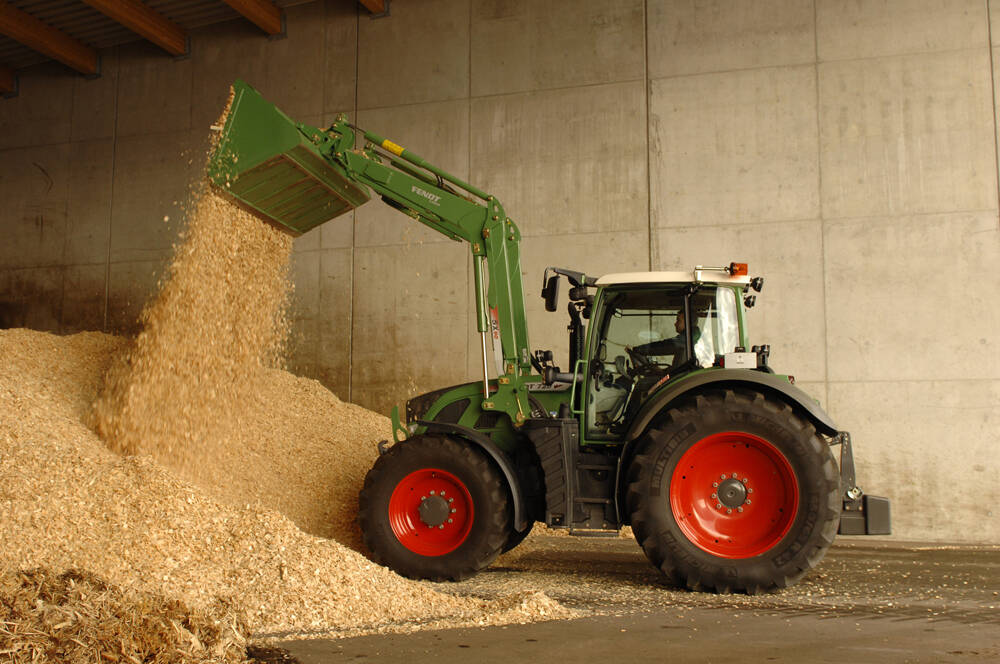
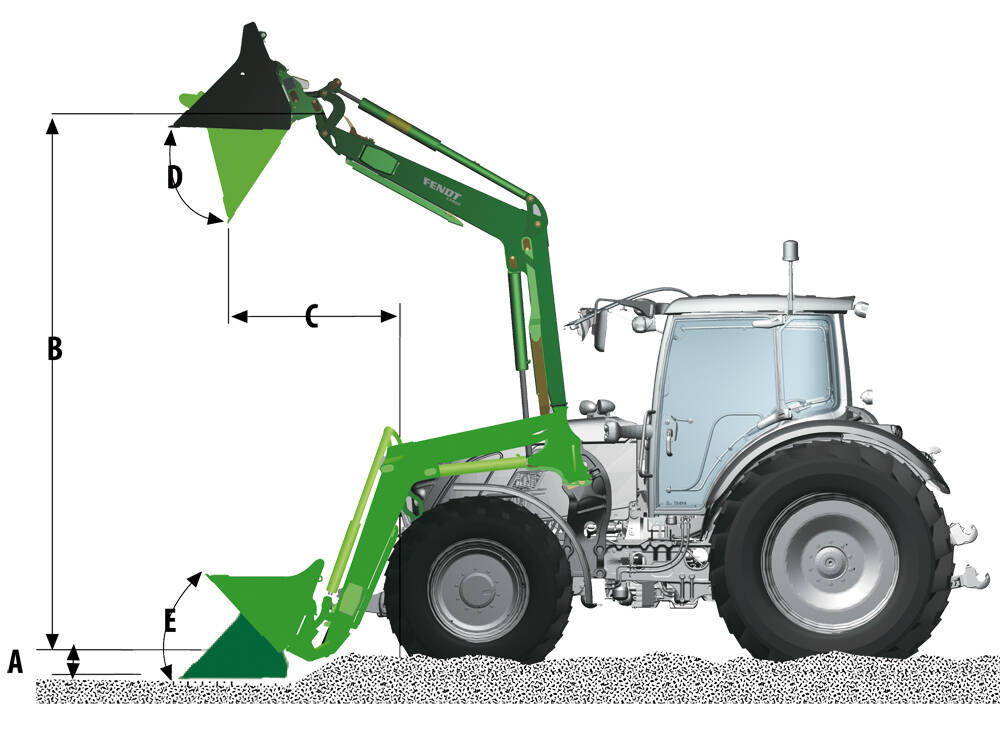
Excellent working conditions with the front loader are ensured not only by the panoramic cabin glass covering the front part of the roof, but also by the front loaders themselves, which come in three modifications. Cargo. Depending on the model, the cargo lifting height reaches 4.5m, and the longitudinal travel is up to 1.87m.
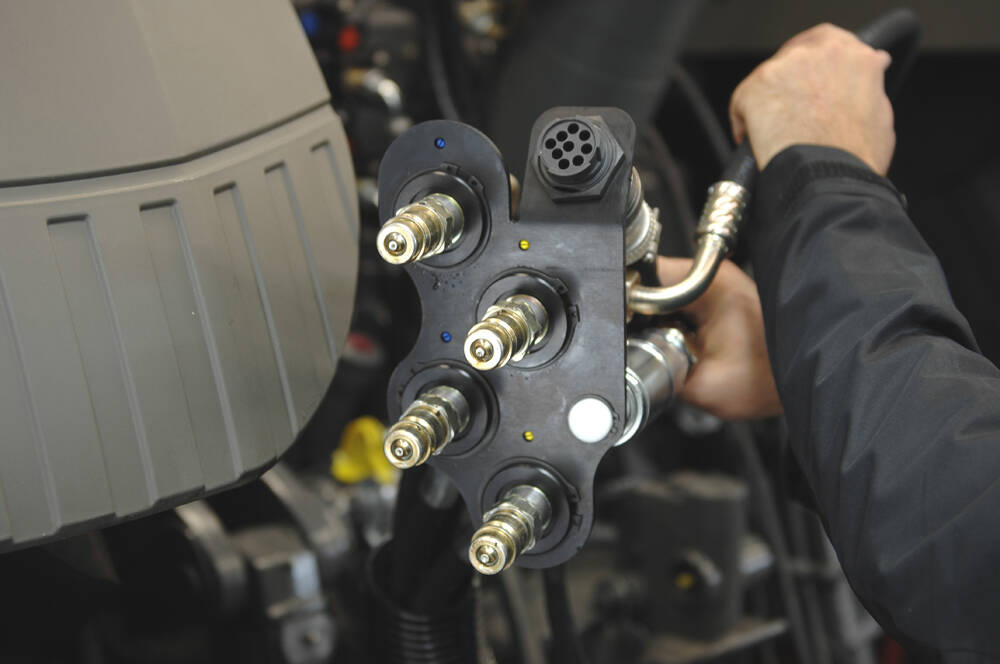
To make working conditions easier for operators in all new tractors with „Fendt Efficient Technology“ status – 700, 800 or 900 Vario For rapid connection of power units, hydraulic and electrical lines can be connected using one of two single-action couplings. Plug and Work. Up to six hydraulic connections can be connected simultaneously, saving time on individual connections and preventing potential connection errors. If some connections are not used during the work process, for example, the pressureless direct oil return or data exchange line between the tractor and the implement ISO-Bus, The free position determined by them.
Another technical innovation that has arrived with the new „Fendt 700 Vario“ is the rear hitch parking position. There is currently a trend towards wider use of the lower hitch on tractors. This offers better load distribution and increased traction due to additional loading of the tractor's drive wheels. This is one of the main advantages of using the lower hitch. However, when turning, the tractor's lower hitch drawbars can interfere with the implement's drawbar or power take-off shaft.
New 700 Vario in the series, as in the more powerful models 800 at 900 Vario, A lift is being installed, in which the lower pull rods can easily be moved to a safe upper position. The lower pull rods are raised upwards into the so-called parking position by releasing their fixings. They are re-secured in the uppermost edge position.
By shortening and lifting the lower control arms, more space is created between them and the linkage or GTV.900 Vario (an additional 15 cm is gained in the series). The technical solution offered by „Fendt“ increases the tractor's manoeuvrability, allowing for the avoidance of equipment damage.


